7 Laser Engraved Crystal Glass Keepsakes for Bride and Groom Milestones
Felix stared at the framed photo on his desk. Sun bleach had washed out Maya’s dress into a featureless smudge, and humidity had curled the paper edges inside the frame. Three years after their vows on a wind-whipped Maine bluff, their favorite wedding picture was ruined. Paper fades. Acrylic scratches within months. Soda-lime window glass turns sickly green under desk lamps. Felix needed a medium that wouldn't yellow or degrade over fifty years.
His search led him to high-density K9 optical crystal. Unlike standard decorative glass containing iron impurities or lead, optical-grade K9 crystal is completely bubble-free, ultra-clear, and engineered for high light refraction. When paired with subsurface laser technology, it converts flat wedding photos into dense 3D point clouds suspended inside solid glass.

How Subsurface Laser Engraving Works Inside K9 Crystal
Felix initially assumed laser engraving meant dragging a beam across the glass surface. That traditional method is surface etching. It creates a rough texture on the outside, prone to catching dust and grease.
Subsurface laser engraving (SSLE) operates on a completely different physical principle. Industrial technicians use a diode-pumped solid-state (DPSS) green laser tuned to a 532 nm wavelength. This green light passes straight through the polished exterior of lead-free K9 crystal without marking the surface. The laser optics focus the beam to a precise focal point inside the glass interior.
At that focal point, thermal energy causes localized micro-cracking. Each pulse vaporizes a microscopic point in the molecular grid of the crystal. By firing thousands of pulses per second, the system plots up to 2000 DPI (dots per inch) resolution into the block. The result is a spatial point cloud that reflects ambient light, creating depth, shadows, and volumetric form.
If you try this technique on cheap soda-lime glass, thermal shock shatters the entire piece. Soda-lime cannot handle the rapid heat spikes from a 532 nm laser. Pure K9 optical crystal absorbs the localized stress without fracturing the surrounding area.
Selecting Photos for Optimal Engraving Depth
Felix learned that high laser DPI cannot fix a poor source image. To get photorealistic 3D depth, your input file requires sharp lighting contrast and high resolution.
- Contrast levels: Mid-tones work best. Pure white dresses without shadows lack depth data for the laser software. Direct sunlight that creates black shadows under eye sockets will translate into hollow gaps in the crystal.
- Resolution baseline: Supply an uncompressed file of at least 300 DPI at full scale. Low-resolution JPEG compression artifacts render as strange floaters inside the crystal.
- Background isolation: Cluttered venue backgrounds confuse 3D conversion algorithms. Isolating the bride and groom against a clean backdrop allows the laser software to properly map facial features and hair contours.
1. The First Look 3D Portrait Cube
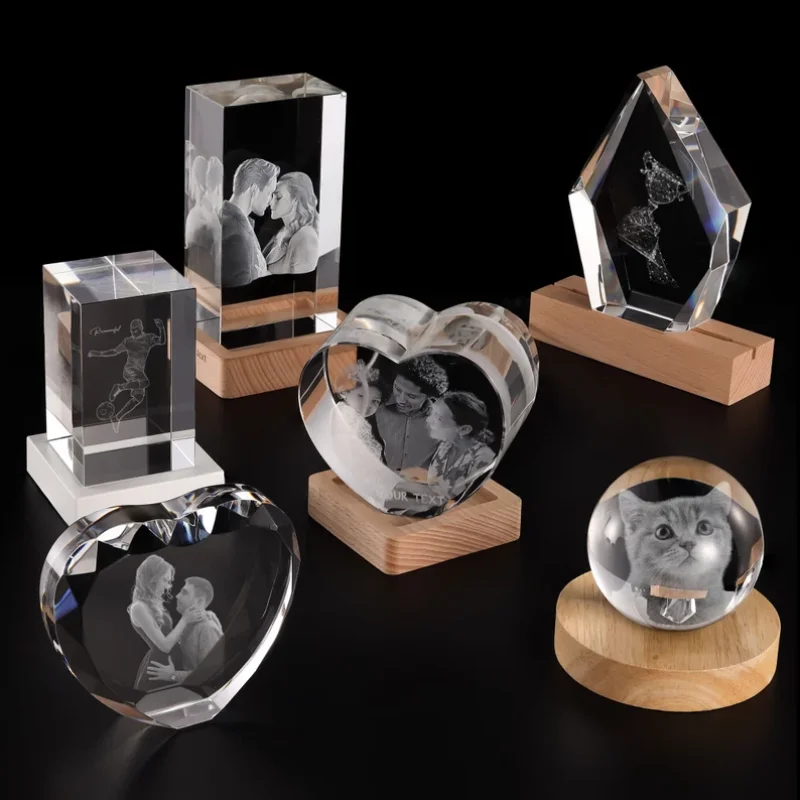
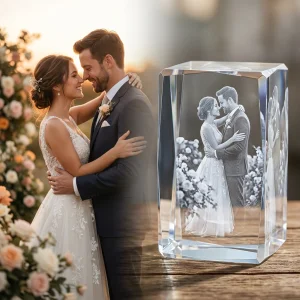
Felix chose a heavy 4-inch K9 crystal cube for their first look photo. When viewed from the front, the laser-rendered figures of Felix and Maya stand isolated in space, three-dimensional from a 180-degree viewing angle.
The volumetric point cloud captures the subtle drape of Maya’s veil and the texture of Felix's suit jacket. Because the subsurface point cloud relies on light diffusion, placing the cube on an active RGB LED display base changes its appearance throughout the day. Warm white light creates a soft classic look, while cool blue highlights accentuate the fine micro-cracks along the edges of the gown.
2. The Engraved Vow Block with Dual-Layering
For couples looking to pair text with imagery, dual-layer crystal blocks combine surface etching with subsurface engraving. The bride and groom's handwritten vows are etched onto the back outer surface using deep sandblast etching, filled with silver rub-and-buff enamel.
Inside the optical center of the block, the 532 nm green laser places a 3D relief of the ring exchange. Looking through the polished front face produces a dramatic parallax effect. The vows sit in the visual background, while the hands and rings float front and center. This technique makes personalized wedding gifts visually layered rather than flat.
3. The First Dance Beveled Heart Keepsake
Heart-shaped optical glass can look cheap if cut improperly. Premium K9 heart keepsakes feature hand-polished wide bevels that act as prisms, bending surrounding light directly into the subsurface image zone.
Felix opted for a heavy 6-inch hand-cut heart for Maya’s desk. The laser software mapped their first dance pose, converting the movement of the gown into half a million micro-fractures. Because heart geometries have angled sides, light bouncing off the internal facets reflects the image multiple times across the interior perimeters, creating a hall-of-mirrors illumination when lit from below.

4. Panoramic Venue and Processional Glass Rectangle
Wide-format venue shots—like a cathedral aisle, an open winery vineyard, or a beach coastline—lose impact on square blocks. Horizontal rectangular slabs measuring 8x5 inches provide the surface area needed for wide focal lengths.
When converting landscape architecture into 3D subsurface point clouds, the laser operates across multiple depth planes. The foreground arbor sits closer to the front face, the bride walking down the aisle occupies the middle ground, and the venue arches recede toward the back face. This multi-depth rendering reproduces real geometric perspective inside a 1.5-inch thick slab of crystal.
5. Faceted Diamond Octagon for Engagement Milestones
Octagonal crystal keepsakes use corner facets to break up light beams. Each cut corner creates additional refraction points, ideal for highlighting small, high-detail objects like engagement rings or detailed embroidery patterns.
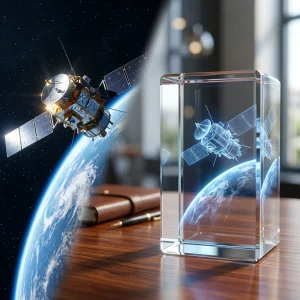
By tuning the DPSS green laser to ultra-high density mode, operators place micro-cracks as close as 10 microns apart. This level of detail allows couples to preserve tiny milestone markers—such as GPS coordinates of the proposal spot, exact wedding timestamps, or soundwave patterns of their "I Do" responses—rendered with vector precision.
6. The Illuminated Clock Tower Portrait Stand
Combining functional decor with custom crystal wedding keepsakes, the clock tower design integrates a quartz clock mechanism into an optical glass pillar. The clock sits set into a pre-drilled recess on the right side, balanced by a vertically oriented 3D portrait on the left.
Because the clock module contains batteries and mechanical gears, direct heat from laser engraving must be avoided near the mounting hole. Technicians engrave the internal portrait first, then precision-grind the clock housing cavity before final high-polish finishing. The heavy base prevents tipping, making it an ideal piece for executive desks or mantelpieces.
7. Etched Crystal Wine Decanter and Stopper Sets
For anniversary toasts, subsurface engraving can be combined with functional barware. Solid K9 crystal stoppers feature laser-engraved wedding monograms suspended inside the top sphere, completely protected from contact with alcohol or wash water.
Unlike standard surface glass etching that wears down after repeated washings, the internal 532 nm laser points remain sealed inside the dense crystal forever. Wine acids, detergent, and friction cannot touch the design. Matching decanters feature external deep sandblast engraving with custom dates, offering a tactile contrast to the smooth optical stopper.
Comparing Keepsake Production Methods
| Feature / Method | 2D Surface Etching | Subsurface 3D Laser (SSLE) | Acrylic / Resin Casts |
|---|---|---|---|
| Material Used | Soda-lime or K9 Glass | Pure K9 Optical Crystal | Petroleum Polymer |
| Image Depth | Flat (Surface only) | Volumetric 3D Point Cloud | Printed Flat Layer |
| UV Yellowing Risk | None | Zero (Lead-free optical) | High (Yellows over time) |
| Surface Wear | Can scratch/collect dirt | Completely smooth surface | Prone to deep scratching |
| Thermal Stability | Moderate | High (Vaporized micro-cracks) | Low (Warps with heat) |
Maintaining and Displaying Crystal Keepsakes
Once Felix placed the completed First Look cube on Maya’s nightstand, he quickly realized that lighting makes or breaks subsurface crystal artwork. Ambient overhead lighting washes out the internal micro-cracks, making the image look faint.
Position your crystal keepsake against a dark, non-reflective background. Dark wood, navy matte walls, or charcoal shelving force the white light refraction from the interior micro-cracks straight into your eyes. For maximum visual impact, use a dedicated LED base. Direct vertical lighting through the bottom edge turns the interior point cloud into a brilliant, glowing sculpture.
Cleaning high-grade K9 crystal requires basic care:
- Avoid harsh ammonia spray cleaners that leave film streaks.
- Use a clean microfiber cloth slightly dampened with distilled water and a drop of isopropyl alcohol.
- Do not submerge illuminated bases or units with glued metal mountings in water.
- Dust the outer surfaces weekly to keep fingerprints from disrupting light transmission through the polished faces.
Felix surprised Maya with the illuminated K9 crystal cube on their fourth anniversary. Unlike their faded paper photo, the subsurface laser-engraved image captured every fold of her gown and every detail of their wedding day in permanent clarity. Sealed deep inside bubble-free optical crystal, that moment won't fade, yellow, or scratch—giving them a clear window straight back to their vows for decades to come.
What is the difference between K9 crystal and standard glass?
K9 crystal is a high-grade optical borosilicate crown glass known for high purity, exceptional clarity, and a high refractive index. It is virtually free of bubbles, streaks, and iron impurities. Standard window or bottle glass (soda-lime glass) contains iron that creates a greenish tint, has lower optical clarity, and cannot withstand the localized thermal stress of subsurface 3D laser engraving without cracking.
Can any photo be converted into a 3D subsurface crystal engraving?
Most clear, well-lit photos can be converted. However, photos with high contrast, sharp focus, and balanced lighting yield the best results. Advanced software converts the 2D image into a 3D model by estimating facial contours and depth layers. Low-resolution images, heavily shadowed faces, or extremely washed-out white clothes reduce the detail density the laser can reproduce inside the crystal.
Will subsurface laser engraved images fade or turn yellow over time?
No. The subsurface engraving process creates microscopic physical fractures deep inside solid K9 optical crystal without using inks, resins, or chemicals. Because there are no organic materials, dyes, or plastics involved, the image will never yellow, fade, blur, or peel—even when exposed to direct sunlight over decades.
Why is an LED display base recommended for laser-engraved crystal keepsakes?
Subsurface 3D images are composed of microscopic fractures that rely on light diffusion to become visible. Without a direct light source, the internal micro-cracks can look faint against light-colored backgrounds. An LED base sends directed light straight up through the bottom edge of the optical crystal, illuminating the entire point cloud and making the 3D portrait stand out clearly.